At Selegance Marketing Services, we are offering complimentary lead generation audits specifically for B2B businesses. Through these audits, I have the chance to meet new business owners, and it’s very interesting to see what they are doing to acquire new clients.
Specifically, I audited a Sydney-based business whose marketing hadn’t generated leads in six months. They’d been spending a lot on LinkedIn ads, but enquiries were inconsistent and of low quality. The first problem I noticed in the audit was the cookie-cutter approach their marketing agency adopted in their messaging. This is why I thought it was a good idea to share this, hoping it helps you too.
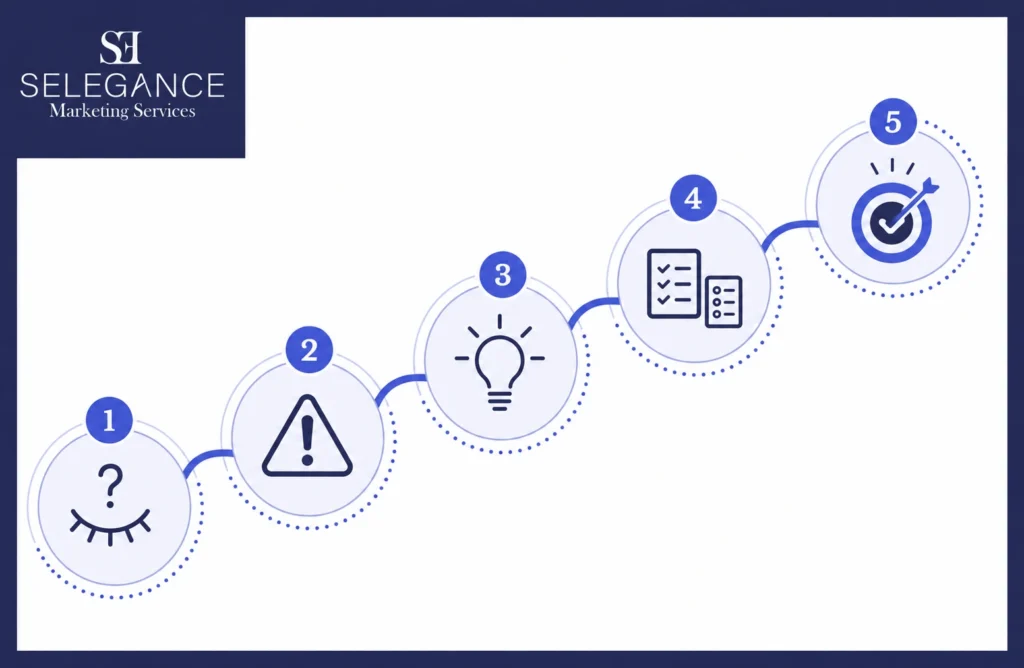
What Are the Five Stages of Buyer Awareness?
Generally, a person purchasing something new goes through five stages of awareness. This is also true in B2C, but it is even more important in B2B because sales cycles can be long and complex and may involve different personas. Therefore, you need to create the right message for the right person at the right time.
1. Unaware
Someone who doesn’t even know they have a problem. The unaware are usually hard to market to. Trying to convince them they have a problem will be an uphill battle, although that’s what many funded start-ups with a revolutionary idea do to market their unknown product. The best way to connect with the unaware is by echoing an attitude they can identify with.
2. Problem aware
Someone who has a problem but doesn’t know there are solutions to that problem. A problem-aware prospect is in pain but doesn’t yet know about any potential solutions, including yours. Their searches on Google often start with “how to + desired outcome.”
3. Solution aware
Someone who knows there are solutions but hasn’t chosen one and doesn’t know about your solution. A typical search query for someone at this stage would be something like “best + desired outcome.”
At this stage, these prospects are good targets for content marketing that gives them tools to help them measure or understand their problem in a way that lines them up for your solution.
4. Product aware
Someone who knows about your solution or product but isn’t sure it solves their problem or hasn’t chosen you over your competitors.
They’re aware they have a problem, and they know you have a potential solution to it, but they’re unsure of how and if you will solve their problem. A typical search query at this stage would be “X vs. Y.” Lead nurturing and social proof, such as case studies, are essential for prospects that reach this level of awareness.
5. Most aware
Someone who knows a lot about your solution or product. They’re on the cusp of buying but need to know the specifics.
The most aware are hot leads. They know what you do, know you solve their problems, and they want your solution. They may just need an incentive, a reason, or a deal to buy.
How to Market to Each Stage of Buyer Awareness
Pretend there’s a person who runs a business in Adelaide and is looking for exactly what you offer. Let’s call him Oliver. On his journey to find you, Oliver may move through these stages.
1. Marketing to Unaware Prospects
Oliver doesn’t think he has a problem, so he’s not searching for anything. You can still market to him in this phase, but you will need a huge budget.
How to use marketing in this phase: Use attention-grabbing content and broad-targeting ads to help him recognise his yet-to-surface problem. Focus on situations and frustrations he can identify with.
2. Marketing to Problem-Aware Prospects
Oliver notices something isn’t working in his business. He’s aware he has a problem but doesn’t yet know about any solutions, including yours. At this stage, he’ll Google things like “how to + desired outcome.”
How to use marketing in this phase: Create educational content that explains his problem and helps him understand its causes. This could include articles, videos, or practical resources built around the questions he is already asking.
3. Marketing to Solution-Aware Prospects
Oliver knows he has a problem and now also knows that solutions exist, but he doesn’t know that your business can provide a solution to his problem. A typical thing he may search for on Google would be “best X + desired outcome.”
How to use marketing in this phase: Explain clearly how your solution addresses his needs and desires. Use comparison guides and search-focused content to help him evaluate his options.
4. Marketing to Solution-Aware Prospects
Oliver finds your business. He’s aware he has a problem and knows you have a potential solution, but he’s unsure whether it will solve his problem. He’ll now be Googling “your business name vs. your competitor’s business name.”
How to use marketing in this phase: Create content and social proof that highlight how your solution works and why, clearly explaining what makes it different. Things like case studies, video testimonials, and competitor comparisons will reduce Oliver’s uncertainty and help him see you as a trustworthy choice.
5. Marketing to Most-Aware Prospects
Oliver knows what you do. He knows you can solve his problem, and he wants your solution. He may just need an incentive to buy.
How to use marketing in this phase: Make the next step simple and remove any remaining barriers to buying. Use clear calls to action, consultations, trials, or tailored offers to give him a compelling reason to act now.
Paid Advertising and the Five Stages of Buyer Awareness
Paid ads can be used throughout the client journey (in fact, I recommend it), but it doesn’t replace the marketing fundamentals behind these stages. It only amplifies your message and places it in front of more people. If the message does not match the audience’s level of awareness, increasing the advertising budget not only won’t solve the problem, but will make it worse.
Think of advertising as an amplifier for a musical instrument. No matter how much you turn up the volume, the money you spend on ads, you won’t move your audience if you are playing the wrong notes at the wrong point in the song.
Why Buyer Awareness Matters in B2B Marketing
As you can now see, a cookie-cutter approach to messaging, especially in B2B, rarely works. The Sydney business I audited spent thousands on LinkedIn trying to serve conversion-focused ads to prospects who were still in the problem-aware phase. No wonder they were not responding. If fundamentals like these aren’t in place, the result will be the same: wasted money. If you want help working out the messaging for your B2B business, get in touch.


